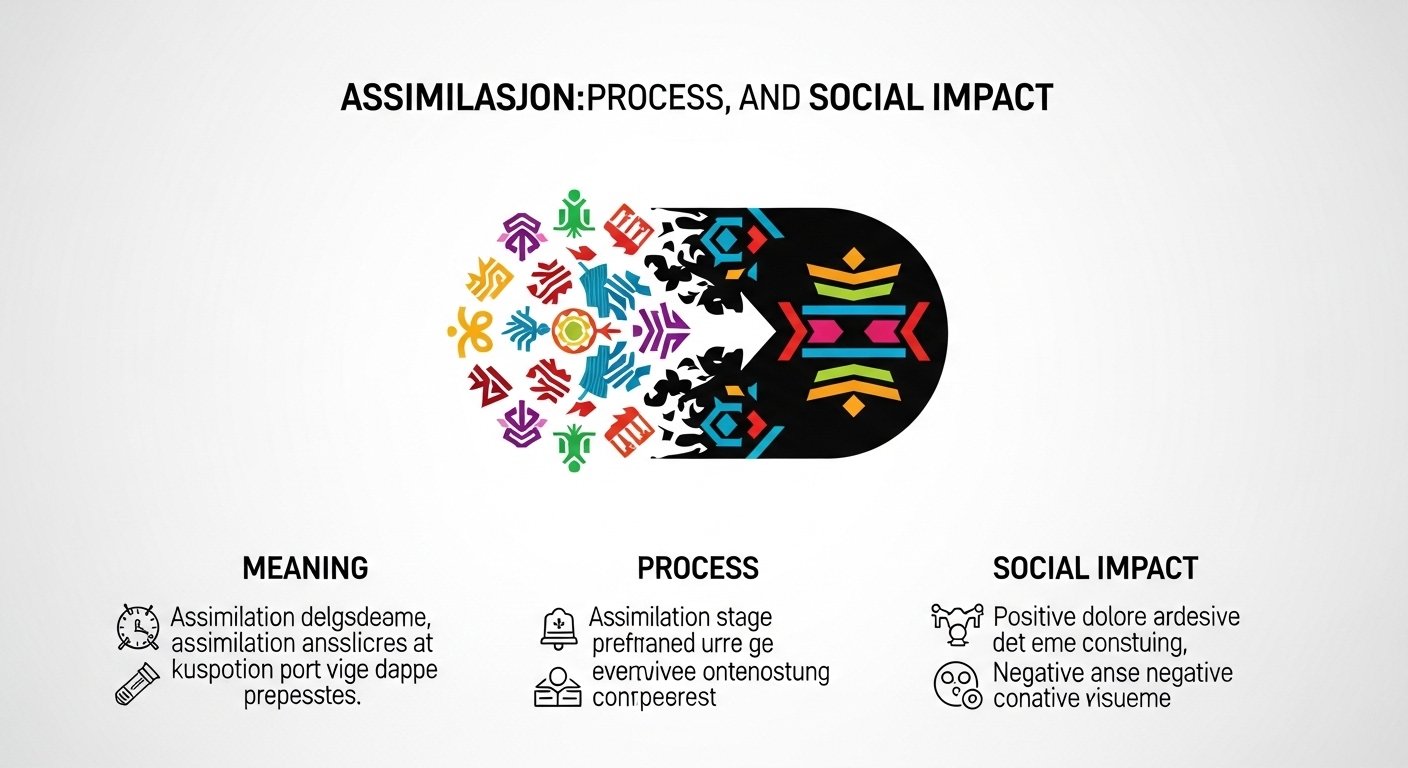
Assimilasjon: Meaning, Process, and Social Impact

Introduction
In an increasingly globalized world shaped by migration, multiculturalism, and cross-border interaction, the concept of assimilasjon has become central to discussions about identity, society, and cultural coexistence. Whether examining immigrant experiences, minority cultures, or national identity policies, assimilation plays a powerful role in shaping how individuals and groups adapt to dominant social norms.
This article explores assimilasjon—its meaning, process, and social impact—while analyzing its benefits, criticisms, and relevance in modern multicultural societies.
What Is Assimilasjon?
Assimilasjon (Assimilation) refers to the social, cultural, and psychological process through which individuals or groups adopt the values, behaviors, language, and norms of a dominant culture.
It often occurs when immigrants or minority communities settle in a new society and gradually become similar to the mainstream population.
Key Characteristics
- Adoption of dominant language
- Acceptance of social norms and customs
- Participation in mainstream institutions
- Reduced cultural distinctiveness over time
Assimilation can be voluntary, gradual, or sometimes influenced by social, political, or economic pressures.
Historical Background of Assimilation
Assimilation has long been a feature of human civilization, especially during periods of:
- Colonial expansion
- Mass migration
- Nation-building efforts
- Industrialization
Examples
- United States (19th–20th century): Immigrants were encouraged to adopt “American” values.
- European nation-states: Language assimilation policies promoted national unity.
- Indigenous populations: Often faced forced assimilation through education and governance systems.
Historically, assimilation was viewed as necessary for national cohesion—but modern perspectives are more nuanced.
The Assimilation Process Explained
Sociologists describe assimilation as a multi-dimensional process rather than a single event.
1. Cultural Assimilation
This occurs when individuals adopt:
- Dress styles
- Food habits
- Religious practices
- Social etiquette
Example: Second-generation immigrants celebrating mainstream national holidays.
2. Linguistic Assimilation
Language adoption is often the fastest assimilation marker.
- Learning the dominant language
- Reduced use of native language
- Language shift across generations
Language fluency improves:
- Employment opportunities
- Education access
- Social integration
3. Structural Assimilation
This involves integration into key institutions:
- Schools
- Workplaces
- Government systems
- Social networks
When minority groups gain equal access to these structures, assimilation deepens.
4. Marital Assimilation
Intermarriage between cultural groups accelerates assimilation by blending traditions, identities, and social ties.
5. Psychological Assimilation
Individuals begin to feel emotionally connected to the dominant culture, developing a shared national or social identity.
Milton Gordon’s Stages of Assimilation
Sociologist Milton Gordon proposed seven stages:
- Cultural assimilation
- Structural assimilation
- Marital assimilation
- Identification assimilation
- Attitude reception assimilation
- Behavior reception assimilation
- Civic assimilation
His model highlights how assimilation progresses from surface-level adaptation to deep social acceptance.
Assimilation vs Integration: Key Differences
Though often used interchangeably, assimilation and integration differ significantly.
| Aspect | Assimilation | Integration |
|---|---|---|
| Cultural identity | Reduced or lost | Preserved |
| Social adaptation | One-sided | Mutual |
| Diversity | Decreases | Maintained |
| Policy approach | Uniformity | Multiculturalism |
Integration allows cultural coexistence, while assimilation emphasizes cultural uniformity.
Social and Psychological Impact
Assimilation shapes both individuals and societies.
Positive Social Impacts
- Stronger national unity
- Reduced cultural conflict
- Improved economic mobility
- Shared civic identity
Psychological Effects
Positive:
- Sense of belonging
- Social acceptance
- Expanded opportunities
Negative:
- Identity loss
- Cultural alienation
- Generational conflict
- Pressure to conform
For many immigrants, balancing heritage and assimilation creates emotional complexity.
Benefits of Assimilation
1. Economic Advancement
Assimilated individuals often gain:
- Better employment prospects
- Higher income mobility
- Professional networking access
2. Educational Opportunities
Language and cultural familiarity improve academic success.
3. Social Cohesion
Shared norms reduce misunderstanding and social fragmentation.
4. Political Participation
Assimilated communities are more likely to:
- Vote
- Engage civically
- Influence policy
Criticism and Challenges
Despite benefits, assimilation faces strong criticism.
1. Cultural Erasure
Critics argue assimilation can:
- Eliminate minority languages
- Suppress traditions
- Weaken cultural diversity
2. Forced Assimilation
Historical policies often coerced minorities, such as:
- Indigenous boarding schools
- Cultural bans
- Religious restrictions
3. Identity Conflict
Second-generation immigrants may struggle between:
- Family heritage
- Societal expectations
4. Inequality Barriers
Assimilation does not guarantee acceptance. Discrimination can persist despite adaptation.
Modern Perspectives on Multiculturalism
Today, many societies favor multiculturalism over strict assimilation.
Multicultural Approach
- Encourages diversity
- Protects minority rights
- Promotes cultural exchange
Countries like Canada and Australia adopt policies supporting cultural pluralism rather than uniform assimilation.
Real-World Examples of Assimilation
United States
- “Melting pot” ideology
- English language dominance
- Intergenerational assimilation patterns
France
- Emphasis on secular national identity
- Limited public religious expression
Japan
- Strong cultural homogeneity expectations
- Limited immigration assimilation pathways
Scandinavia
- Balance between welfare integration and cultural adaptation expectations
Future Trends and Insights
Assimilation is evolving due to globalization and digital connectivity.
Emerging Trends
- Hybrid identities (bicultural/multicultural)
- Digital cultural communities
- Transnational families
- Remote work migration
Younger generations increasingly identify with multiple cultures simultaneously rather than fully assimilating.
FAQ: Assimilasjon
1. What does assimilasjon mean?
Assimilasjon refers to the process by which individuals or groups adopt the culture, norms, and identity of a dominant society.
2. How is assimilation different from integration?
Assimilation reduces cultural differences, while integration allows groups to maintain their cultural identity within a shared society.
3. What are the stages of assimilation?
They include cultural, structural, marital, identification, and civic assimilation, among others.
4. Is assimilation positive or negative?
It can be both—offering opportunity and cohesion while risking cultural loss and identity conflict.
5. What is an example of assimilation?
Immigrant families gradually adopting a new language and national customs over generations.
Conclusion
**Assimilasjon—its meaning, process, and social impact—**remains one of the most influential sociological concepts in understanding migration, identity, and cultural change. While assimilation can promote unity, opportunity, and shared belonging, it also raises critical concerns about cultural preservation and social equity.